
Newsletter Articles
March Newsletter Articles
Steady Hands, Faithful Vision: A Long-Term Approach to Investing God’s Resources
 Wesleyan church leaders are entrusted with a sacred responsibility: to steward resources that ultimately belong to God for the sake of His mission. In seasons of market volatility—when headlines are unsettling, portfolios fluctuate, and uncertainty feels close at hand—it becomes even more important to anchor our decisions not in fear, but in faithful, long-term vision.
We are living in a time where financial markets shift rapidly. Inflation concerns, interest rate changes, geopolitical tensions, and economic uncertainty all contribute to short-term swings in market value. These fluctuations can tempt leaders to react quickly—pulling back, moving to cash, or attempting to “time the market.” While such responses may feel prudent in the moment, they often undermine the very goals we seek to accomplish for long-term ministry impact.
As stewards of God’s resources, we are called to something deeper than reaction—we are called to wisdom.
A Wesleyan understanding of Biblical stewardship recognizes that God is the owner of all things, and we are trustees. This perspective changes how we approach investing. We are not merely protecting assets; we are cultivating them for future Kingdom work. Endowments, reserve funds, and long-term investments exist not just for today’s needs, but for tomorrow’s ministry—funding mission, supporting clergy, resourcing outreach, and ensuring that the church remains a vibrant witness in its community for generations to come.
This is why a long-term view is essential.
Historically, financial markets have demonstrated a consistent pattern: short-term volatility, but long-term growth. While any given year—or even several years—may include downturns, the broader trajectory of diversified market investments has been upward over decades. This long-term growth is what enables church funds to outpace inflation, preserve purchasing power, and expand their capacity for ministry.
When we focus too heavily on short-term fluctuations, we risk missing this larger picture. Selling investments during downturns locks in losses. Sitting on the sidelines waiting for the “right time” often results in missing the market’s recovery—periods that can be both rapid and significant. In contrast, a disciplined, long-term approach allows us to participate in the full arc of market growth.
Emotional investing is one of the greatest threats to faithful stewardship. Fear during downturns and overconfidence during peaks can lead to decisions that are inconsistent with sound financial principles. As leaders, we must resist the urge to react emotionally and instead remain grounded in a thoughtful, well-constructed investment strategy aligned with our mission and time horizon.
Scripture calls us to wisdom, patience, and trust—qualities that are especially important in times like these. Just as a farmer does not uproot crops at the first sign of a storm, we do not abandon long-term investment strategies in response to temporary market conditions. Instead, we remain steady, trusting that faithful cultivation over time yields fruit.
A long-term investment approach also aligns with our missional calling. When we prioritize growth and market value over time, we increase the resources available for ministry. This means more scholarships, more outreach, more support for congregations, and a greater capacity to respond to the needs of our communities. By maintaining a long-term perspective, we are not just managing money—we are multiplying impact.
This does not mean ignoring risk or avoiding prudent oversight. It means building a diversified portfolio, setting clear objectives, and regularly reviewing performance—always with an eye toward long-term outcomes rather than short-term noise.
In volatile times, steady hands and faithful vision matter most. As trustees of God’s resources, we are called to look beyond the immediate moment and invest with confidence in the future God is still shaping. The markets may rise and fall, but our mission remains constant—and our stewardship must reflect that enduring purpose.
Thank you for your faithful trust and partnership with the Methodist Foundation of Mississippi. We are honored to be the shepherd of your church’s funds. Please reach out to us with any questions, concerns or thoughts as we all navigate today. We always enjoy an opportunity to come visit or talk on the phone. You can reach us at 601-948-8845, via email at todd@methodistfm.org or our website at www.methodistfm.org
Foolish or Faithful; Owner or Trustee
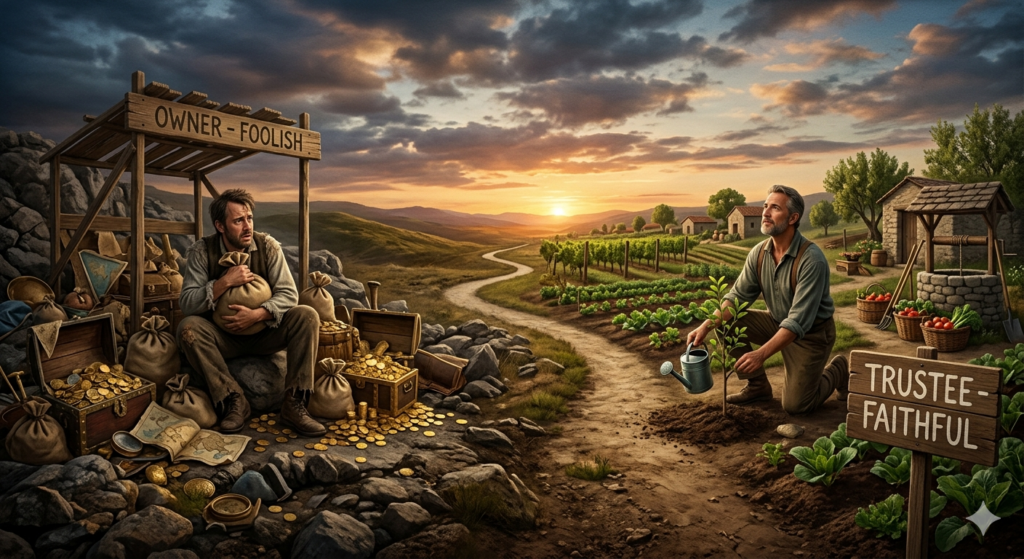 In Wesleyan theology, as reflected in Saving Grace (Abingdon Press), the Gospel does more than secure our eternity—it reshapes our daily lives, including how we view and use money. Our financial decisions become an expression of discipleship. The question before us is simple but profound: Are we living as foolish owners, or faithful trustees?
Jesus offers a sobering warning in Luke 12:
“Take care, and be on your guard against all covetousness, for one’s life does not consist in the abundance of his possessions.”
And he told them a parable, saying, “The land of a rich man produced plentifully, and he thought to himself, ‘What shall I do, for I have nowhere to store my crops?’ And he said, ‘I will do this: I will tear down my barns and build larger ones…’ But God said to him, ‘Fool! This night your soul is required of you… So is the one who lays up treasure for himself and is not rich toward God.”
—Luke 12:15–21 (ESV)
The rich man in this parable was not condemned for being productive or successful. His folly was deeper—he believed the resources were his, for his purposes, and for his security. His language reveals it: my crops, my barns, my goods. This is the worldview of ownership, where money becomes a source of identity, control, and false assurance.
This mirrors the broader cultural narrative. The world tells us that money is ours to earn, ours to spend, and ultimately, ours to define our success. Accumulation becomes the goal, and self-sufficiency the measure of security. Yet Jesus calls this way of thinking foolish—not because wealth itself is evil, but because misplaced trust is.
In contrast, the biblical vision is one of stewardship. Scripture consistently teaches that God is the true owner of all things: “The earth is the Lord’s and the fullness thereof” (Psalm 24:1). We are not owners—we are trustees. A trustee manages resources on behalf of another, with accountability and purpose.
To live as a trustee is to recognize that every dollar entrusted to us carries a divine assignment. It shifts the question from “What do I want to do with my money?” to “What does God want me to do with His?” This perspective frees us from the anxiety of ownership and invites us into the joy of participation in God’s work. A Biblical view of stewardship transforms not only our hearts but also our habits—aligning our financial lives with God’s kingdom purposes.
Practically, this stewardship touches five key areas of our financial lives:
- Earning – Honoring God through diligence and integrity in our work
- Giving – Reflecting God’s generosity as a first priority, not an afterthought
- Saving – Exercising wisdom and planning for future needs
- Debt – Avoiding bondage and pursuing freedom
- Spending – Making intentional choices that align with our values
At the center of these is the discipline of a spending plan. A spending plan is not about restriction—it is about alignment. It ensures that we direct the money entrusted to us, rather than being directed by impulse, culture, or circumstance. When we assign purpose to every dollar, we move from reaction to intention, from anxiety to stewardship.
A simple approach begins with clarity: understand your income, prioritize giving, allocate for essentials, plan for saving, and set boundaries for discretionary spending. The goal is not perfection, but faithfulness—bringing order to our finances so they reflect God’s priorities.
In the end, the difference between foolishness and faithfulness is not measured by how much we have, but by how we see it. Are we owners building bigger barns, or trustees building God’s kingdom?
Questions for Reflection:
- In what ways do my financial habits reflect ownership rather than stewardship?
- How might my decisions change if I truly viewed all my resources as entrusted by God?
- What is one step I can take this week to better align my earning, giving, saving, debt, or spending with God’s purposes?
Hope, Sacrifice, and Generosity: A Holy Week Reflection
Growing up in the Catholic faith, Holy Week was a time of prayer and quiet thought. I remember being nine or ten, tears streaming down my face in church as everyone around me chanted, “Crucify Him!” For the first time, the weight of Christ’s sacrifice truly struck me. My parents, embarrassed, tried to hush me, but after the service, our priest softly told me my tears were a gift, showing I understood the sorrow and the profound gift of Christ’s death and resurrection.
Even today, Holy Week makes me pause and reflect. (I haven’t been a member of a Catholic church in over 25 years.) That childhood memory returns each year, deepening my experience as I study the scriptures. When I read Matthew 27 and hear Jesus say, “My God, my God, why have you forsaken me?” I feel a wave of emotion. He repeats the first line of Psalm 22 on purpose. His cry means more than pain; it points to a psalm that moves from heartbreak to hope to victory. Jesus knew how powerful those words were.
Psalm 22 begins in shadow, heavy with abandonment. As each verse unfolds, despair and hope twist together in a whirlwind of feeling. Gradually, the tone of the psalm warms, recalling God’s faithfulness, longing for rescue, and finally bursting into a victorious cry: “He has done it!”
By choosing this psalm in his last breaths, Jesus embraced the depths of human pain and pointed us toward the promise of redemption. His words assure us that God hears our cries and that despair is never the final chapter. Remembering Christ’s victory in His resurrection reminds us of our belief. We believe that through His sacrifice, death itself has been overcome.
Just as Psalm 22 transitions from sadness to praise, the cross leads us to resurrection. Even when our prayers start in sadness and fear, God is shaping an ending bright with hope. Holy Week- sorrow shifting to silence, then joy- mirrors our own rhythms. The cross is not the end. It is the bridge from suffering to renewal, a reminder that, with God, hope always has the final word. As we carry our burdens, may we trust that every Good Friday leads to Easter, and that in Christ, every story, no matter its sorrow, can rise into light.
This same hope and trust guide our financial giving. When we offer gifts, large or small, we join the story of resurrection. We let go of comfort, trusting God to multiply what we give for His use. Our generosity becomes faith: planting seeds in uncertainty, knowing God will bring joy and abundance. As we give, may we remember acts of generosity, rooted in the cross and resurrection, that help share Christ’s hope with others.
Happy Easter. He is risen indeed! ~Jennifer